

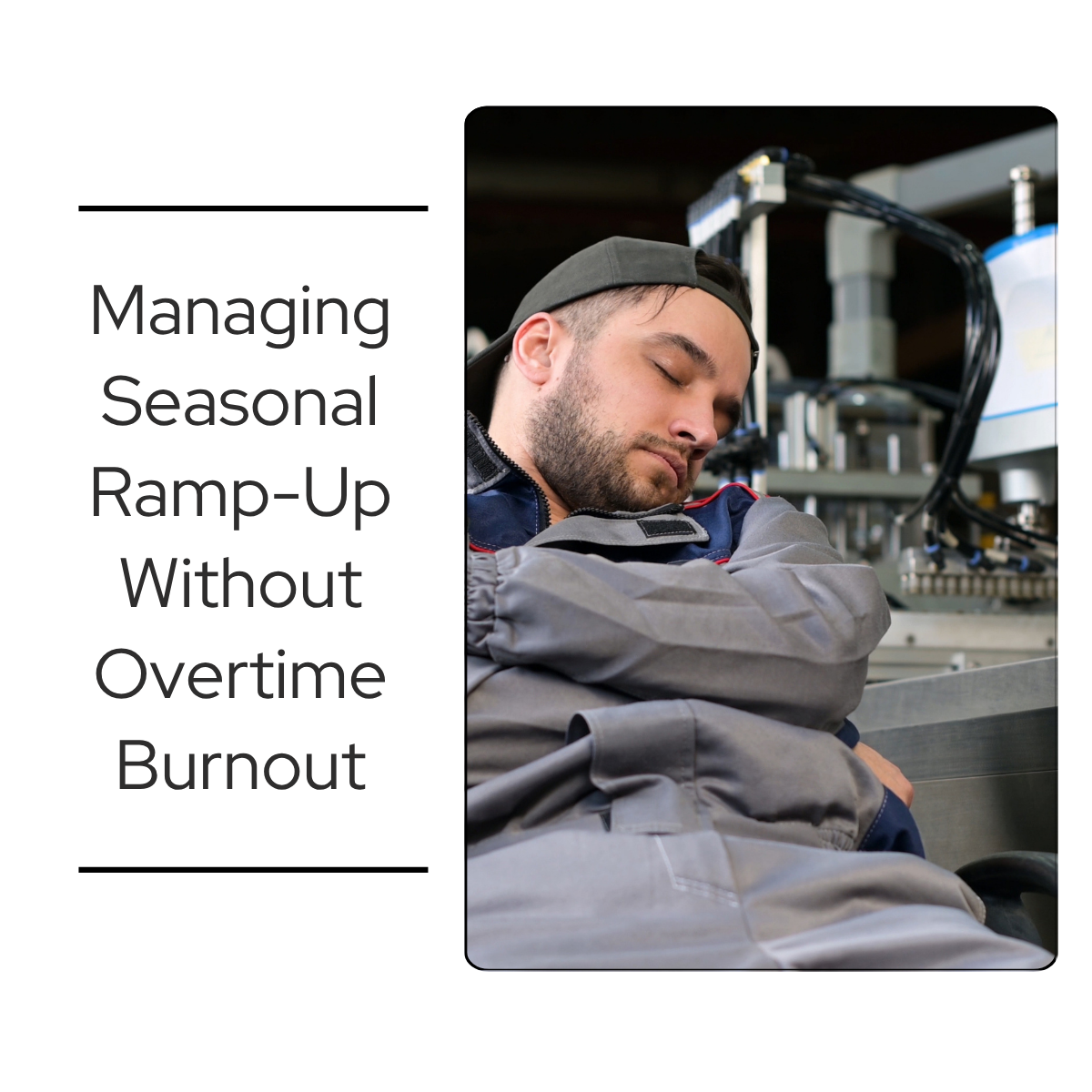
Peak season adds volume fast, and the first move in most plants is the same: add hours to the current team. Overtime does not require new hiring or new onboarding, which makes it the easiest lever to reach for. It is also the one with the shortest runway.
What Extended Hours Actually Cost
The U.S. Bureau of Labor Statistics reports weekly overtime in manufacturing averaged 3.8 hours in 2025, up from 3.6 hours the two years before. That climbs quickly once a plant adds a real seasonal surge on top of it. OSHA’s research on worker fatigue found that accident and injury rates run 18 percent higher on evening shifts and 30 percent higher on night shifts compared to day shifts, and that 12-hour shifts carry a 37 percent higher injury risk overall. Extended hours do not just wear workers down. They change the odds on the floor.
Why a Fixed Headcount Cannot Absorb a Real Spike
Seasonal demand tends to hit as a step change rather than a gradual climb, and a fixed headcount working more hours has a hard limit on what it can safely absorb. The strain rarely announces itself. It shows up as a defect rate that creeps upward, a near-miss log that fills in faster than usual, or a supervisor covering for two people instead of one. By the time any of that gets noticed, the plant is already deep into peak season with less margin to fix it.
Building Capacity Ahead of the Surge
Adding workers ahead of a surge protects both output and the people already on the floor. A staffing partner earns its place here by keeping a pipeline of screened workers ready before volume spikes, with onboarding and safety orientation already handled, instead of scrambling once the plant is already behind. A partner who tracks seasonal patterns and raises lead time needs early is doing a different job than one who only responds to open requisitions.
The Bottom Line
Overtime works as a short-term buffer, not a full peak season strategy. Plants that pair it with staffing capacity built ahead of the surge tend to protect quality and keep experienced workers through the season, rather than running them down right when volume peaks.
Contact us to talk through how a flexible staffing plan can support your next peak season.